
Within the colossal infrastructure of China’s industrial sector, particularly its dominant steel and non-ferrous metals industries, lies a critical yet often overlooked component: the slag crusher plant. These facilities are not merely waste processors; they are sophisticated material recovery hubs that transform industrial byproduct—slag—into valuable secondary resources. Examining samples from these plants offers a profound insight into China’s approach to industrial ecology, technological advancement, and circular economy principles. This article provides a detailed, professional analysis of the slag crusher plant ecosystem in China, focusing on the significance of samples, operational processes, technological configurations, and market implications.
Before analyzing the crusher plant, one must understand the feedstock. Slag is a non-metallic byproduct generated during the smelting and refining of ores. In China, the primary types are:
A “sample” of raw slag is heterogeneous, containing variable amounts of metallic iron (Fe), calcium silicates, iron oxides, alumina, and other compounds. Its physical state can range from molten (pre-treatment) to rocky lumps post-cooling. The primary goal of a crusher plant is to liberate and recover entrapped metallic components and process the remaining mineral matrix into sized aggregates for construction use.
A modern Chinese slag crusher plant is a coordinated system far beyond a single crushing machine. A typical flow process for handling steel slag samples involves:
Step 1: Pre-treatment & Sampling
Incoming slag is first inspected and sampled. Advanced plants use mechanical grab samplers to obtain representative samples for lab analysis (determining metal content, chemistry, and hardness). This data dictates downstream processing parameters.
Step 2: Primary Crushing
Large slag lumps (often up to 1 meter in size) are fed into a primary crusher. Jaw Crushers are predominantly used here for their robustness and high reduction ratio. Hydraulic toggle adjustment systems allow quick setting changes to accommodate varying sample hardness.
Step 3: Metal Liberation and Recovery
The primary crushed material undergoes magnetic separation—typically using suspended self-cleaning cross-belt magnets or drum magnets—to recover coarse metallic iron (>90% purity), which is returned to the steel mill as a valuable feed.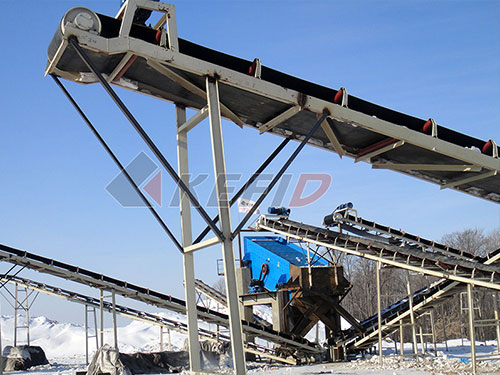
Step 4: Secondary and Tertiary Crushing
The non-magnetic fraction proceeds to secondary crushing (Cone Crushers are favored for their ability to handle abrasive materials with steady output) and sometimes tertiary crushing (Impact Crushers or fine cone crushers). This stage aims to further liberate any remaining small metal beads and achieve the desired aggregate size.
Step 5: Screening and Final Separation
Multi-deck vibrating screens classify the material into commercial fractions (e.g., 0-5mm, 5-10mm, 10-20mm). Each stream may pass through final-stage magnetic separators or even eddy current separators in advanced plants to recover non-ferrous metals.
Step 6: Stockpiling and Dispatch
The final products—cleaned slag aggregates of various sizes and recovered metal—are stockpiled under cover to prevent dust pollution before dispatch.
China’s engineering in this field has evolved from basic crushing setups to highly automated systems.
In this context, “samples” hold multiple meanings:
Analysis of these samples reveals trends:
The proliferation of these plants is driven by:
However challenges persist:
China’s slag crusher plant landscape represents a mature intersection of heavy industry environmental management resource recovery technology A detailed examination of its processes equipment reveals an industry that has moved far beyond simple waste disposal Through systematic sampling intelligent system design embracing automation wear-resistant innovation these plants turn potential environmental liabilities into economic assets contributing significantly towards sustainable industrial development The continued evolution towards smarter greener more integrated facilities will serve as both domestic necessity potentially an exportable model global markets facing similar challenges industrial solid waste management
Lorem ipsum dolor sit amet, consectetur adipisicing elit. Consectetur sequi saepe ut sunt eveniet perferendis excepturi, iste obcaecati. Qui tempore hic sed quia soluta obcaecati vel.