China’s Quarry Ballast Crushing Equipment Factories: The Engine of Global Infrastructure
The relentless pace of global infrastructure development, from high-speed rail networks and transcontinental highways to sprawling port facilities and urban megaprojects, rests upon a fundamental, often overlooked component: high-quality quarry ballast. This coarse aggregate, comprising crushed stone of specific size and shape, forms the stable foundation layer for railways and the critical sub-base for roads. At the heart of producing this essential material lies a sophisticated industry—the manufacturing of quarry ballast crushing equipment. Within this global landscape, China has emerged not merely as a participant but as a dominant force, with its factories serving as the primary engine supplying both domestic and international markets.
This article provides a comprehensive analysis of China’s quarry ballast crushing equipment sector, examining the key drivers behind its growth, the technological evolution of its products, the structure of its manufacturing ecosystem, and the challenges and opportunities it faces on the world stage.
The Bedrock of Demand: Domestic and Global Drivers
The ascendancy of China’s crushing equipment industry is inextricably linked to its own unprecedented domestic infrastructure boom. Initiatives like the “Belt and Road Initiative” (BRI), which funds and constructs infrastructure across Asia, Africa, and Europe, along with massive internal projects such as the national high-speed rail system—the world’s largest—have created a voracious, sustained demand for ballast. Chinese factories initially developed and scaled up to meet this internal need, achieving economies of scale that are virtually unattainable elsewhere.
This domestic crucible provided manufacturers with several critical advantages:
- Volume Production: The scale of Chinese construction projects necessitated equipment that was not only effective but also capable of continuous, high-tonnage operation. This pushed manufacturers to design robust, high-capacity crushers, screens, and entire production lines.
- Rapid Iteration and Adaptation: Operating in a fast-paced environment, manufacturers learned to quickly adapt their designs to process a wide variety of raw materials—from hard granite and basalt to abrasive limestone—prevalent across China’s diverse geology.
- Cost Competitiveness: Leveraging extensive supply chains and lower labor costs (though this advantage is gradually narrowing), Chinese factories mastered the production of reliable equipment at highly competitive price points.
As domestic markets matured and competition intensified, these factories naturally turned their gaze outward. The same cost-effectiveness and proven performance that served domestic projects became compelling value propositions for developing nations in Southeast Asia, Africa, and South America embarking on their own infrastructure journeys.
Technological Evolution: From Basic Crushers to Smart Quarries
The international perception of Chinese manufacturing has shifted dramatically from being solely a source of low-cost alternatives to a hub of genuine innovation and quality. This is particularly true in the heavy machinery sector.
1. Core Equipment Portfolio:
Chinese factories produce a complete range of crushing machinery essential for ballast production:
- Jaw Crushers: These serve as the primary crushers, handling the initial size reduction of large blasted rock. Chinese manufacturers offer robust designs with advanced kinematics for higher throughput and better particle shape.
- Cone Crushers: Critical for secondary and tertiary crushing stages, cone crushers are where precise cubical shaping—a key requirement for high-quality railway ballast—occurs. Leading Chinese brands have made significant strides in hydraulic adjustment systems (like multi-cylinder hydraulic cone crushers), automatic control chambers (ASRi-type systems), and wear-part longevity.
- Impact Crushers (Horizontal Shaft Impactors – HSI): Often used for softer rocks or for producing other construction aggregates alongside ballast, HSI crushers are valued for their excellent product shape. Chinese models have improved in rotor design and wear resistance.
- Vertical Shaft Impactors (VSI): Known as “sand makers” in some contexts, these are paramount for shaping aggregate and removing flaky particles to achieve the desired angularity and surface texture for optimal interlock in the ballast bed.
- Supporting Equipment: No crushing circuit is complete without vibrating screens (for precise size separation), feeders, conveyors, and dedusting systems. Chinese factories provide fully integrated solutions.
2. The Shift Towards Integration and “Smart” Technology:
The most significant trend is the move away from selling individual machines toward providing complete “Turnkey Solutions.” A client can contract a leading Chinese manufacturer to design, manufacture, deliver, install, and commission an entire stationary or mobile crushing plant tailored to their specific ore characteristics and output requirements.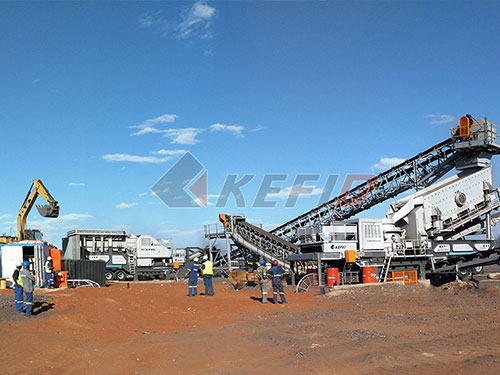
Furthermore,”Intelligent Quarry” concepts are being integrated. This involves equipping plants with IoT sensors that monitor equipment health (predictive maintenance), track production metrics in real-time, optimize crusher settings automatically for maximum yield or desired product shape (using AI algorithms), and manage operational data through cloud platforms. This digital transformation enhances efficiency reduces downtime,and lowers long-term operating costs,making Chinese offerings increasingly sophisticated.
The Manufacturing Ecosystem: A Tiered Structure
The landscape of China’s quarry equipment factories is not monolithic; it is a multi-tiered ecosystem:
- Tier 1 – Global Giants: Companies like SANY, Zoomlion, Liugong,and Sunward have established themselves as global heavy machinery leaders.They invest heavily in R&D operate massive state-of-the-art fabrication facilities,and maintain extensive international sales distribution,and service networks.Their products often compete directly with Western giants like Metso,Sandvik,and Caterpillar in terms of technology while retaining a significant price advantage.
- Tier 2 – Specialized & Established Exporters: This tier consists of numerous companies that have built strong reputations over decades primarily through export.Shanghai Joyal Machinery Co.Ltd.Shibang Industry & Technology Group Co.Ltd.(SBM)and Zhejiang MP Mining Equipment Corp.are prominent examples.They often focus intensely on crushing technology offering highly refined designs reliable performance,and strong customer support.They are agileand responsive catering well to mid-sized international projects.
- Tier 3 – Regional & Niche Manufacturers: Thousands of smaller workshopsand factories cater primarily to the vast domestic market or export to price-sensitive regions with less demanding specifications.They play avital rolein supplying affordable machineryfor small-scale quarries but may vary considerablyin quality consistencyand after-sales service capability.
Challenges Confronting the Industry
Despite its strengths,the industry faces several headwinds that will shape its future trajectory:
- Intellectual Property (IP) Concerns: While improving,the historical issueof IP protection remainsa challenge.Some manufacturers have been accusedof producing near-identical copiesof patented Western designs.This can create skepticismamong some international buyers regarding innovation originality.
- After-Sales Service & Parts Logistics: For a global client,a critical considerationis not justthe machine’s purchase pricebutits total costof ownership.This includes availabilityof genuine spare parts speedof technical supportand expertiseof local service engineers.Establishinga robustglobal service networkisacapital-and time-intensive endeavorwhere Western competitorsstill holdan edgein many regions.
- Rising Production Costs: Wages land costsand raw material pricesin Chinaare steadily increasing.This gradual erosionofthe low-cost advantageforces manufacturersto compete moreon technology brand valueand service ratherthan price alone.
- Global Competition & Geopolitics: Intense competitionfrom established Western playersand rising manufacturersin Indiaand South Korea keeps pressureon market share.Furthermore geopolitical tensionsand trade policiescan disrupt supply chainsandinfluence procurement decisionsin certain countries.
Conclusion: A Formidable Force Poised for Refinement
China’s quarry ballast crushing equipment factories representa formidable pillarof the global construction machinery industry.Forged inthe furnaceof unprecedented domestic demand theyhave achievedscale technological proficiencyand cost-efficiencythat make them indispensable partnersfor infrastructure development worldwide.
The narrative has evolved from oneof pure cost-savingto oneof compelling value.Their future successwill hingeontheir abilityto continuousthe current trajectory: deepening genuine R&D innovation strengthening global serviceandsupport ecosystemsandovertime fully shedding any lingering perceptionsabout IP practicesand quality inconsistency.As they do so theywill not only continue todrive global infrastructurebutalso firmly cementtheir positionas leaders settingthe technological paceinthe heavy crushingequipment sectorfor decadesto come
