Bulk Stone Quarry Crushing Plant Datasheet: Technical Specifications, Operational Parameters, and Engineering Considerations
1. Introduction
A bulk stone quarry crushing plant is a high-capacity, multi-stage processing system designed to convert extracted raw rock (e.g., granite, basalt, limestone, diorite, or traprock) into graded aggregate products for construction, road base, concrete production, and asphalt mixtures. Unlike mobile or semi-mobile units, a bulk (stationary) plant is engineered for continuous, high-throughput operation—typically exceeding 500 metric tons per hour (tph)—and is characterized by integrated feeding, primary, secondary, tertiary, and screening circuits. This datasheet provides a comprehensive technical overview of such plants, covering design criteria, component specifications, electrical and control systems, environmental controls, and maintenance protocols. The document is intended for project engineers, quarry operators, procurement specialists, and regulatory compliance officers.
2. System Architecture and Process Flow
A typical bulk stone quarry crushing plant operates in a closed-loop or open-loop configuration, depending on product requirements. The primary process flow is as follows:
- Raw Material Extraction: Blasted or ripped rock is loaded into haul trucks (typically 40–100 t capacity) and transported to the plant feed hopper.
- Feed Hopper and Grizzly Feeder: A reinforced steel hopper (capacity 50–150 m³) receives the run-of-mine (ROM) material. A vibrating grizzly feeder (VGF) with adjustable amplitude and frequency removes fines (< 50 mm) and scalps oversized boulders (> 900 mm) for secondary breaking (hydraulic hammer or jaw crusher).
- Primary Crushing: A heavy-duty jaw crusher (e.g., 1,200 × 1,000 mm) or a gyratory crusher (e.g., 54/74) reduces ROM to a nominal 150–250 mm. The discharge is conveyed to a surge pile or directly to the secondary circuit.
- Secondary Crushing: A cone crusher (e.g., HP300 or equivalent) or impact crusher (for softer materials) reduces material to 40–80 mm. This stage often operates in closed circuit with a double-deck screen to recirculate oversize.
- Tertiary Crushing and Screening: A short-head cone crusher or vertical shaft impactor (VSI) produces final aggregate sizes (0–5 mm, 5–10 mm, 10–20 mm, 20–40 mm). Multiple vibrating screens (triple-deck, 2.4 m × 6.0 m) classify products. Oversize material is returned via conveyor to the tertiary crusher.
- Product Stockpiling and Loadout: Finished aggregates are conveyed to radial stackers or fixed stockpile conveyors. Loadout via wheel loaders or automated belt scales into trucks or rail wagons.
3. Key Component Specifications
The following table provides representative datasheet values for a mid-to-large capacity plant (1,000 tph nominal). Actual values vary by manufacturer and site conditions.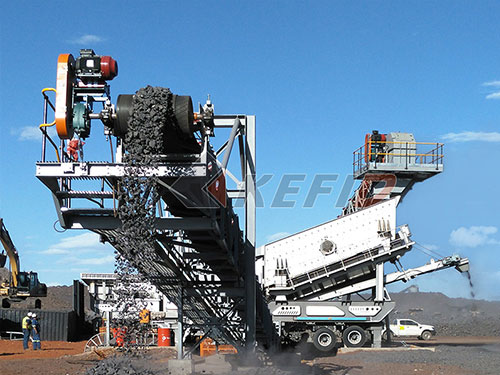
| Component |
Specification |
Notes |
| Feed Hopper |
Capacity: 100 m³; Lined with 20 mm AR400 steel; Discharge opening: 1,500 × 1,500 mm |
Optional hydraulic rock breaker boom |
| Vibrating Grizzly Feeder |
Width: 1,400 mm; Length: 4,800 mm; Stroke: 10–14 mm; Frequency: 600–750 rpm; Motor: 2 × 15 kW |
Grizzly bars with adjustable gap (50–100 mm) |
| Primary Jaw Crusher |
Model: C130 (Nordberg) or equivalent; Feed opening: 1,300 × 1,100 mm; CSS range: 100–200 mm; Capacity: 600–900 tph; Motor: 160 kW |
Hydraulic wedge adjustment; automatic lubrication system |
| Secondary Cone Crusher |
Model: HP400; Max feed: 300 mm; CSS: 25–60 mm; Capacity: 300–500 tph; Motor: 315 kW |
Hydroset system for overload protection |
| Tertiary VSI Crusher |
Model: Barmac B9100SE; Rotor speed: 40–70 m/s; Capacity: 200–400 tph; Motor: 2 × 300 kW |
For cubical product shape; wear parts: tungsten carbide tips |
| Vibrating Screens |
Size: 2.4 m × 6.0 m (triple deck); Amplitude: 8–12 mm; Motor: 2 × 22 kW; Screen media: polyurethane or wire mesh |
Inclination: 15–20°; vibration frequency: 850–1,000 rpm |
| Belt Conveyors |
Belt width: 1,200–1,600 mm; Speed: 2.5–3.5 m/s; Capacity: up to 1,500 tph; Drive: 30–90 kW |
With impact idlers at loading points; skirt boards; belt scales |
| Dust Collection System |
Baghouse filter: 10,000–20,000 m³/h; Filtration area: 500–1,000 m²; Fan motor: 75–110 kW |
Located at crusher discharge and screen feed points |
| Water Spray System |
Nozzles: 20–40 units; Flow rate: 50–150 L/min; Pressure: 5–8 bar |
For dust suppression on conveyors and transfer points |
4. Electrical and Control Systems
A modern bulk crushing plant is fully automated via a Programmable Logic Controller (PLC) and Supervisory Control and Data Acquisition (SCADA) system. Key electrical parameters include:
- Power Supply: 3-phase, 400 V / 50 Hz (or 480 V / 60 Hz), with a dedicated transformer substation (typically 1,000–2,500 kVA).
- Motor Control Centers (MCC): Each crusher, screen, and conveyor has a dedicated starter (soft starter or VFD for high-inertia loads). VFDs are used on feeders and stackers for variable speed control.
- Control Logic: Interlocking sequences ensure that downstream equipment starts before upstream units (e.g., conveyors start in reverse order). Emergency stop (E-stop) pull cords are installed along all walkways.
- Monitoring: Real-time display of motor amperage, bearing temperatures (PT100 sensors), vibration levels (accelerometers on crushers), and belt scale tonnage. Alarm thresholds trigger automatic shutdown to prevent equipment damage.
- Remote Access: Ethernet-based communication allows off-site monitoring and diagnostics via VPN.
5. Structural and Civil Engineering Data
- Foundation: Reinforced concrete (C30/37 grade) with vibration isolation pads under crushers. Foundation depth: 1.5–3.0 m depending on soil bearing capacity (minimum 150 kPa).
- Steel Structure: Hot-dip galvanized or painted structural steel (S355JR) for conveyor gantries, screen platforms, and crusher supports. Wind load design per local codes (e.g., EN 1991-1-4).
- Access and Safety: All platforms have anti-slip grating, double handrails (1.1 m height), and toe boards. Ladders are 45° inclined with safety cages. Emergency lighting and fire extinguishers are installed at every level.
- Noise Control: Crusher and screen enclosures are lined with acoustic panels (50 mm mineral wool, perforated steel facing) to reduce noise to < 85 dB(A) at 1 m distance.
6. Environmental and Regulatory Compliance
Bulk quarry plants are subject to stringent environmental regulations. The datasheet must include:
- Dust Emissions: Particulate matter (PM10) concentration at plant boundary must not exceed 150 µg/m³ (24-hour average) per EU Directive 2008/50/EC. Mitigation: baghouse filters (efficiency > 99%), water sprays, and covered conveyors.
- Noise Limits: Daytime (06:00–22:00) limit: 65 dB(A) at nearest residence; nighttime: 55 dB(A). Mitigation: acoustic barriers, low-noise bearings, and rubber screen media.
- Water Management: Closed-loop water system for dust suppression; sedimentation ponds for runoff. Zero liquid discharge is recommended. pH of recycled water: 6.5–8.5.
- Waste Handling: Reject material (oversize, scalpings) is stockpiled for re-crushing or used as fill. Oil and lubricant containment (drip pans, bunded storage) prevents soil contamination.
- Permitting: Requires Environmental Impact Assessment (EIA), air quality permit, water abstraction license, and noise variance approval. Regular stack testing and ambient monitoring are mandatory.
7. Operational Performance Metrics
- Nominal Capacity: 800–1,200 tph (depending on feed hardness and product mix).
- Reduction Ratio: Primary: 4:1 to 6:1; Secondary: 3:1 to 5:1; Tertiary: 2:1 to 3:1.
- Product Yield: Typical distribution for granite: 0–5 mm (15%), 5–10 mm (20%), 10–20 mm (35%), 20–40 mm (25%), oversize (5% recirculated).
- Availability: Design availability ≥ 90% (excluding planned maintenance). Mean Time Between Failures (MTBF) for crushers: 1,500–2,500 hours.
- Energy Consumption: 0.8–1.5 kWh per ton of crushed product (including conveyors and screens). Specific energy for primary jaw crusher: 0.2–0.4 kWh/t.
- Wear Life: Jaw plates: 300–600 hours (depending on abrasiveness); Cone liners: 400–800 hours; VSI tips: 150–300 hours. Use of high-chrome alloys (e.g., 18% Cr) extends life by 30%.
8. Maintenance and Reliability Engineering
A preventive maintenance (PM) schedule is critical. The datasheet should include:
- Daily Checks: Lubrication levels (crusher oil, gearbox oil), belt tension, screen mesh integrity, hydraulic pressure, and dust collector differential pressure.
- Weekly Checks: Vibration analysis on crusher bearings, belt alignment, wear liner thickness (using ultrasonic gauges), and conveyor roller condition.
- Monthly Checks: Oil sampling and analysis (ISO 4406 cleanliness code), torque check on all bolted connections, and calibration of belt scales.
- Annual Overhaul: Full crusher rebuild (replacement of main shaft bushings, eccentric, and thrust bearings), screen deck replacement, and structural weld inspection.
- Spare Parts Inventory: Critical spares (crusher liners, bearings, belts, hydraulic pumps) should be stocked for 3–6 months of operation. Lead time for custom castings: 8–12 weeks.
9. Cost Estimation and Economic Data
- Capital Cost (CAPEX): For a 1,000 tph stationary plant, estimated at USD 15–25 million (excluding civil works and land). Major cost drivers: crushers (40%), screens (15%), conveyors (20%), electrical/control (15%), and installation (10%).
- Operating Cost (OPEX): USD 1.5–3.0 per ton of product. Breakdown: energy (30%), wear parts (25%), labor (20%), maintenance (15%), and environmental compliance (10%).
- Payback Period: Typically 5–8 years, assuming aggregate selling price of USD 8–15 per ton and 70% capacity utilization.
10. Safety and Human Factors
- Lockout/Tagout (LOTO): All energy sources (electrical, hydraulic, pneumatic) must be isolated before maintenance. Multiple lock points on crusher chambers.
- Fall Protection: Full-body harnesses with anchor points required when working above 2 m. Guardrails on all open edges.
- Dust Exposure: Operators must wear N95 respirators in dusty areas. Silica exposure limits: 0.05 mg/m³ (8-hour TWA) per OSHA.
- Training: Annual certification for crusher operators, conveyor belt maintenance, and confined space entry. Emergency drills (fire, entrapment) every 6 months.
11. Conclusion and Recommendations
The bulk stone quarry crushing plant is a complex, capital-intensive asset that demands rigorous engineering design, precise operational control, and proactive maintenance. This datasheet serves as a baseline for procurement, commissioning, and performance benchmarking. For site-specific applications, the following adjustments are recommended:
- Material Hardness: For quartzite or basalt (abrasion index > 0.5), use high-chrome liners and reduce VSI rotor speed to 50 m/s.
- Moisture Content: For wet clay or high-moisture feed (> 5%), install a washing drum before the primary crusher to prevent clogging.
- Altitude: For sites above 2,000 m, derate electric motors by 10–15% due to reduced air density.
- Modularity: Consider a semi-mobile design (crawler-mounted primary) if the quarry face moves every 2–3 years.
Finally, it is imperative to engage a qualified engineering consultant for detailed design, finite element analysis (FEA) of critical structures, and dynamic simulation of the crushing circuit. Properly executed, a bulk stone quarry crushing plant will deliver reliable, high-quality aggregate for decades, with a return on investment that justifies its substantial upfront cost.
