
In the vast and intricate ecosystem of global infrastructure development, the production of aggregates—crushed stone, sand, and gravel—forms the foundational layer upon which modern civilization is built. Within this critical industry, rock crushers are the indispensable workhorses, transforming massive, raw geological formations into the precisely sized materials required for construction. The name “Ashok Rock Crusher” evokes a specific entity within this sector, often representative of a robust, medium-to-large-scale aggregate processing plant. While “Ashok” is a common proper name in several regions, particularly South Asia, this analysis will treat “Ashok Rock Crusher” as a archetypal model or a representative company to explore the technology, processes, economic significance, and environmental considerations inherent to such operations.
At its essence, an Ashok Rock Crusher is not a single machine but a complex system of interconnected components designed for comminution—the reduction of large rocks into smaller, specific size fractions. The primary objective is to take blasted or excavated rock from a quarry face and process it into saleable products like coarse aggregate for concrete, base materials for road construction (sub-base, base course), railway ballast, or even manufactured sand.
The operational principle revolves on applying massive mechanical force to overcome the natural compressive strength of the rock. This force can be applied through several mechanisms:
An Ashok plant would typically integrate multiple crusher types in stages to achieve efficient and controlled size reduction.
A well-designed Ashok Rock Crusher setup operates as a closed-circuit system to optimize efficiency and product quality. The process can be broken down into several key stages:
a) Primary Crushing:
The process begins at the primary crusher, usually a robust Jaw Crusher or a Gyratory Crusher. This unit is designed to handle the largest run-of-quarry (ROQ) rocks, often measuring over a meter in diameter. Its function is to perform the initial, coarse reduction, breaking down the massive boulders into manageable pieces typically under 200-250mm. The heavy-duty nature of this stage requires significant power and rugged machinery built to withstand immense stress and abrasion.
b) Secondary Crushing:
The output from the primary crusher is conveyed to the secondary crushing stage. Here, Cone Crushers are most commonly employed. Cone crushers operate by compressing rock between a gyrating spindle and a concave hopper. They are excellent for producing well-shaped, medium-sized aggregates (e.g., 20mm – 40mm). Their ability to handle hard and abrasive rocks makes them ideal for producing high-quality aggregate for asphalt and concrete.
c) Tertiary and Quaternary Crushing:
For applications requiring even finer products or superior particle shape (cubicity), tertiary and sometimes quaternary crushers are used. At this stage, Vertical Shaft Impactors (VSI) or finely tuned cone crushers come into play. VSIs are particularly valuable as they use a high-speed rotor to accelerate rocks and cause them to fracture upon impact with an anvil or other rocks. This “rock-on-rock” crushing action produces highly cubical particles and is the primary method for producing manufactured sand (M-Sand), a critical alternative to natural river sand.
d) Screening and Classification:
Integral to every stage is screening. Vibrating screens separate the crushed material into various size fractions before and after each crushing stage.
An Ashok Rock Crusher plant’s efficiency depends on its supporting infrastructure: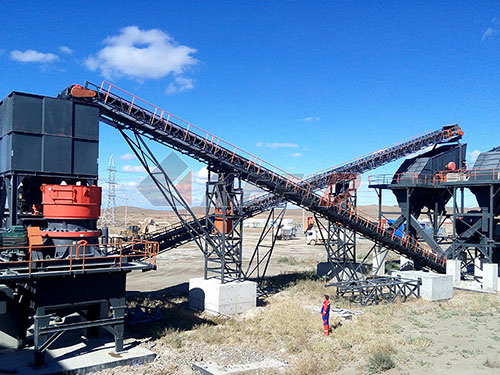
An operation like Ashok Rock Crusher plays a vital role in regional and national economies.
The aggregate industry faces legitimate environmental challenges which any modern Ashok Rock Crusher must address proactively
a) Dust Emissions:
Crushing screening
and conveying processes generate significant dust (PM10 PM2 5)
Mitigation:
Installation of comprehensive dust suppression systems including water sprays enclosures around transfer points
and baghouse filters (fabric filters) that capture dust from crusher vents
b) Noise Pollution:
The machinery involved operates at high noise levels
Mitigation:
Use of acoustic enclosures around generators
and crushers sound-dampening materials on conveyor hoods
and strategic placement of noise barriers (berms/walls) around the plant perimeter
c) Water Management:
While water is used for dust suppression it can lead to runoff containing fine sediment
Mitigation:
Construction of sedimentation ponds or silt traps where runoff water is held allowing suspended solids to settle before the water is discharged or recycled
d) Resource Depletion Landscape Impact:
Quarrying permanently alters the landscape
Mitigation:
Adherence to scientifically sound quarry plans that include phased land reclamation Post-operational plans often involve re-greening creating reservoirs or repurposing the land for recreational use restoring ecological value
An entity like Ashok Rock Crusher whether viewed as specific company or archetype represents far more than simple machinery It embodies sophisticated process engineering integral economic development
and profound environmental responsibility Its multi-stage crushing circuit meticulously transforms raw bedrock into graded aggregates that form literal foundation modern society As global demand construction materials continues grow driven urbanization infrastructure renewal evolution such plants towards greater automation energy efficiency environmental stewardship will remain critical balancing needs progress with imperative sustainable resource management
Lorem ipsum dolor sit amet, consectetur adipisicing elit. Consectetur sequi saepe ut sunt eveniet perferendis excepturi, iste obcaecati. Qui tempore hic sed quia soluta obcaecati vel.