
In the vast, productive landscape of the American Midwest, Iowa stands as a cornerstone of agricultural and industrial output. Beneath its fertile soil lies another critical resource: the bedrock and deposits that form the foundation of modern infrastructure—aggregate materials. The transformation of raw, quarried rock into the specific, graded products essential for construction is a sophisticated process driven by two pivotal types of machinery: crushers and screens. In Iowa, where infrastructure maintenance, agricultural development, and commercial expansion are perpetual, the role of aggregate screens and crushers is not merely supportive but foundational to the state’s economic and physical framework.
Before delving into the machinery, it is crucial to understand the product itself. Aggregate refers to a broad category of coarse particulate material such as sand, gravel, crushed stone, and recycled concrete. In Iowa, these materials are indispensable. They form the literal base of the state’s development:
The quality, consistency, and availability of these materials are directly determined by the efficiency and capability of the crushing and screening operations scattered across the state.
Crushers are responsible for reducing large quarried rock or reclaimed concrete into smaller, manageable sizes. The process is rarely accomplished by a single machine; it is typically a multi-stage system designed for maximum efficiency and product control.
Primary Crushing: This is the first reduction stage. Large dump trucks feed massive boulders (sometimes several feet in diameter) into a primary crusher. In Iowa,Jaw Crushers are commonly used for this task. They function like a giant V-shaped vise, with one stationary “jaw” and one moving jaw that compresses the rock against it until it fractures.Gyratory Crushers are another primary option for very high-volume operations.
Secondary Crushing: After primary crushing, the material is still too large for many applications (typically ranging from 6 inches down). Secondary crushers take over to refine it further.Cone Crushers are workhorses in this stage in Iowa’s aggregate industry. They compress rock between a gyrating spindle and a concave hopper, producing a more uniform cubical product ideal for high-quality concrete mixes.Impact Crushers are also widely used; they use high-speed impact rather than compression to break rock or recycle materials like concrete and asphalt. They excel at producing a well-shaped product but may generate more fines (dust).
Tertiary/Quaternary Crushing: For specifications requiring very precise sizing or further refinement of shape (cubicity), additional crushing stages may be employed using specialized cone crushers or vertical shaft impactors (VSIs). VSIs throw rock against anvils or other rocks at high velocity in a process called “rock-on-rock” crushing.
Crushing alone is insufficient; it produces a mixture of various-sized fragments. Screening is the critical separation process that sorts this mixture into saleable products meeting exact customer specifications.
Screens are vibrating machines featuring surfaces with precisely sized openings called meshes or decks.
In an Iowa quarry or recycling yard,Scalping Screens might be used before primary crushing to remove unwanted fine material or natural sand.Inclined Screens are ubiquitous in processing plants after crushers to sort material into final product stockpiles.Horizontal Screens offer greater accuracy for finer separations.
Iowa’s aggregate industry is served by both local quarries owned by regional companies like River Products Company or Martin Marietta’s strategic locations across the state as well as independent contractors who provide mobile crushing services directly at job sites.
Technology has dramatically transformed operations: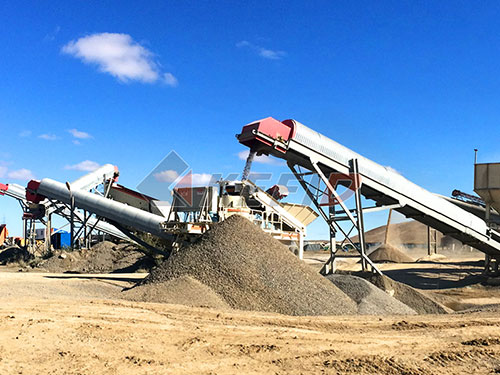
The aggregate industry represents hundreds of millions of dollars in economic activity annually within Iowa.It provides essential raw materials while creating skilled jobs not only within quarries but also within equipment dealerships,supporting logistics networks,and specialized service industries dedicated to maintaining complex machinery.The health of this sector serves as an economic indicator closely tied with public works spending levels set forth by bodies such as The Iowa Department Of Transportation(IDOT).
Looking ahead,the demand driven by ongoing infrastructure bills will ensure robust activity.Future advancements will likely involve greater electrification options replacing diesel power,further integration artificial intelligence(AI) predictive analytics optimizing entire circuits,& continued innovation improving durability wear parts combating abrasive nature Midwestern limestone granite deposits found throughout Iowan geology bedrock formations underlying its fertile topsoil layers supporting dual economies agriculture mineral extraction working tandem sustain state’s growth prosperity generations come ultimately demonstrating how humble rocks processed powerful sophisticated machinery truly build world around us
Lorem ipsum dolor sit amet, consectetur adipisicing elit. Consectetur sequi saepe ut sunt eveniet perferendis excepturi, iste obcaecati. Qui tempore hic sed quia soluta obcaecati vel.